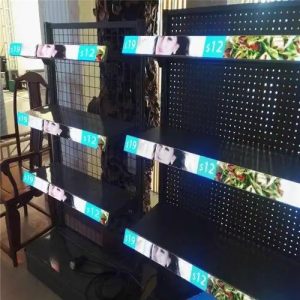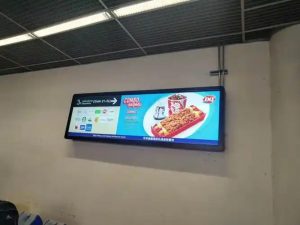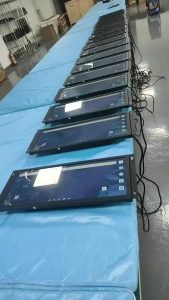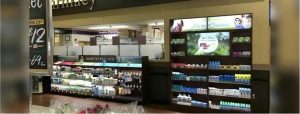

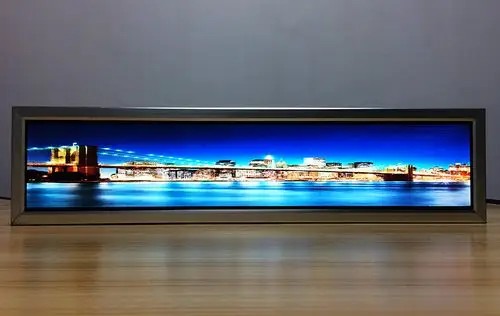
When specifying shelf-edge digital signage displays, procurement managers and systems integrators frequently wrestle with a core question: Should we select LCD or LED technology?
Both display technologies have distinct merits, but excel in fundamentally different environments. Retail shelving presents unique operational conditions: viewing distances are intimate—shoppers stand mere feet away—and installations are almost exclusively indoors. Keeping these operational realities in mind makes the technical comparison clear and straightforward.
First, let us clarify the terminology to prevent common confusion: ‘LCD’ refers to liquid crystal displays that utilize an internal LED backlight behind an optical liquid crystal layer to modulate imagery. ‘LED displays’ refer to panels composed of direct-emitting discrete LED lamp diodes. Some promotional literature refers to ‘LED-LCDs,’ which are simply LCD panels with LED backlights. Understanding this distinction is essential during procurement.
1. Image Quality: For Close-Range Viewing, LCD Delivers Superior Fidelity
Shelf-edge displays prioritize close-range optical rendering above all else.
LCD panels deliver high pixel density, razor-sharp typographic contours, and smooth, natural color gradients. Fine pricing digits, ingredient lists, and promotional copy remain completely crisp and legible without visible pixel grain.
Direct-view LED screens are composed of discrete lamp beads separated by physical spacing (pixel pitch). While pixel pitch is imperceptible from across a large hall, viewing an LED screen from arm’s length reveals noticeable dot-matrix pixelation. Achieving smooth, high-density visuals on an LED screen at close range requires ultra-fine-pitch diodes (such as P0.9 or Micro-LED), which causes manufacturing costs to escalate dramatically.
Therefore, when screens are mounted directly along shelf tiers where shoppers stand inches away, LCD is the superior technical and visual choice.
2. Luminance: LED Wins on Raw Brightness, but Shelf Environments Do Not Require It
In terms of raw luminous output, direct-view LED holds a clear advantage, capable of reaching thousands of nits. Consequently, LED is the undisputed industry standard for outdoor billboards, sun-drenched facades, and long-range arenas.
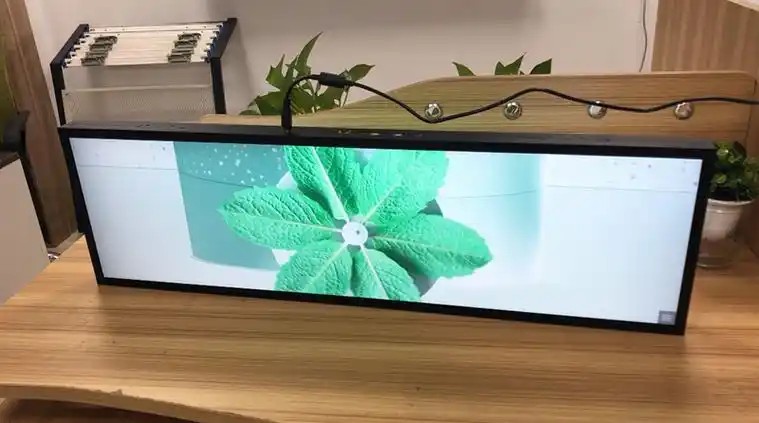
However, commercial retail shelving is installed indoors under controlled ambient lighting (typically 300 to 500 lux). In these environments, standard commercial LCD luminance (300 to 700 nits) provides clear, vibrant visibility. For close-up viewing, excessive brightness produces uncomfortable ocular glare and unnecessary power consumption.
The choice is application-dependent: for outdoor or sun-exposed spaces, select LED; for indoor retail shelving, standard commercial LCD luminance is completely optimal.
3. Price and Commercial Value: Evaluated at Target Visual Resolution
Pricing must be evaluated relative to target visual clarity rather than raw square footage.
For expansive displays viewed from twenty or thirty feet away, standard-pitch LED panels offer competitive cost per square meter. However, when shelf displays require shoppers to read fine typography and inspect product photography up close, LED requires ultra-fine pixel pitch, causing unit costs to surge steeply.
At close-range viewing distances, LCD achieves razor-sharp 1080p or 4K resolution at far more economical price points. Furthermore, LCD manufacturing processes are mature for elongated non-standard aspect ratios. Total costs vary based on dimensions, brightness, resolution, and quantity, so evaluate comprehensive specifications rather than unit price alone.
4. Operating Lifespan: Both Meet Commercial Standards, but Quality Dictates Durability
Direct-view LED diodes have inherently long operational lifespans. The lifespan of an LCD panel depends primarily on its backlight array, which, under certified industrial-grade design, easily delivers 50,000+ hours of continuous commercial operation.
In real-world retail deployments, durability depends far more on component quality and thermal management: LED diode binning, optical light-guide materials, thermal chassis airflow, daily duty cycles, and ambient humidity. Rather than relying on generic longevity claims, verify that the manufacturer executes disciplined factory burn-in testing and provides comprehensive warranty protections.
The Verdict: How to Choose for Your Shelf Deployment
To summarize the decision framework:
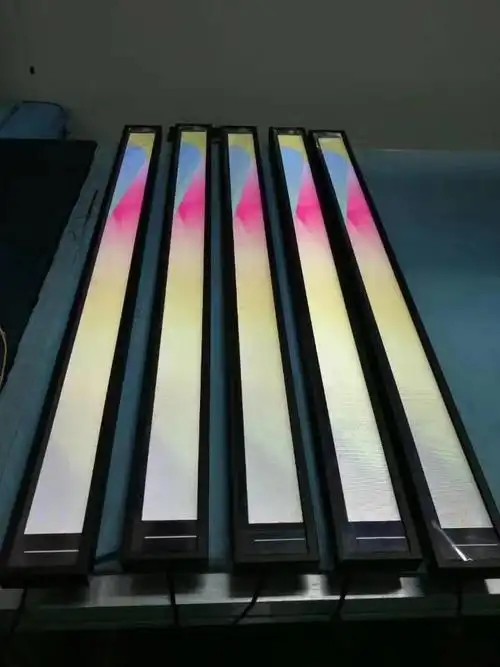
Select LCD Stretched Displays: When screens mount along indoor retail shelving, shoppers view content from close range, displays feature fine typography and high-resolution merchandise photography, and non-standard custom sizing is required. LCD provides superior image fidelity, economical cost control, and mature custom sizing.
Select Direct-View LED Displays: When displays operate outdoors or in direct sunlight, or when applications require long-range viewing across grand public halls or massive seamless video walls.
Prior to procurement, define three criteria: physical installation position and viewing distance; ambient illumination conditions; and target dimensions and project volumes. Clarifying these three points will definitively guide your selection.
Frequently Asked Questions (FAQ)
Are shelf stretched screens predominantly LCD or LED in modern retail? Indoor retail shelving predominantly utilizes LCD stretched displays because close-up viewing demands high pixel density that LCD delivers cost-effectively. LED is reserved primarily for outdoor or large-scale long-distance signage.
Is LCD brightness sufficient for retail shelf lighting? Yes. Under typical supermarket and pharmacy lighting, commercial LCD panels provide ample contrast. For locations adjacent to exterior glass windows, high-brightness LCD configurations (up to 1,000+ nits) are available.
Can LCD stretched displays be manufactured to custom non-standard shelf lengths? Yes. Retail shelf lengths vary widely. ZXTLCD provides custom dimensional engineering to match the exact length and bracket requirements of your store gondolas.
Conclusion
Neither LCD nor LED is universally superior; each excels in its intended operational domain. For the vast majority of indoor retail shelf applications, LCD stretched displays offer decisive advantages in optical fidelity, cost-effectiveness, and customized spatial integration.
ZXTLCD specializes in commercial-grade LCD stretched bar displays. If you are specifying displays for store fit-outs, share your shelf dimensions, environmental parameters, and unit counts with us to evaluate the ideal solution. Official website: www.stretchedbarlcd.com
Explore Related Commercial Stretched Bar LCD Models
If you are sourcing high-reliability stretched display hardware for this application, consider these featured commercial specifications:
- 28 Inch Android Stretched LCD Bar for Shelf-Edge Signage
- 47.1 Inch Android Stretched Bar LCD Screen for Shelf Edges
Need a Custom Screen Size or Turnkey Project Quote?
ZXTLCD provides full ODM/OEM customization for commercial projects—including ultra-wide aspect ratios, sunlight-readable high brightness, custom mounting brackets, and Android/Windows CMS software integration.