
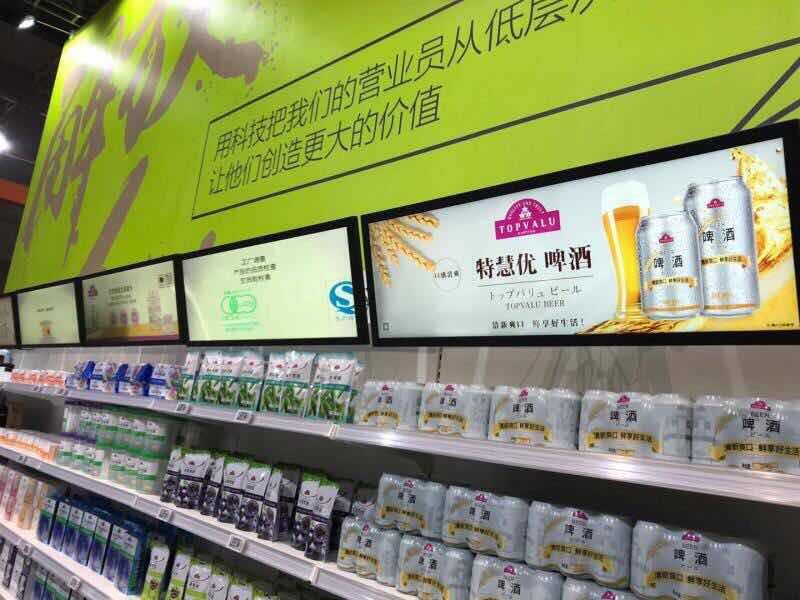
When discussing whether paper price tags will be completely replaced, many industry articles jump to a sweeping conclusion: stretched bar digital displays are the inevitable future. As manufacturers of stretched displays, we could easily make the same marketing claim. However, the commercial truth is: the optimal choice depends entirely on your specific retail store profile. For certain stores, upgrading delivers immediate labor savings; for others, it merely incurs unnecessary capital expenditure.
Answering these four fundamental operational questions will clarify whether transitioning to digital displays makes authentic commercial sense for your business.
Question 1: How Frequently Do You Change Prices Each Month?
This represents the foremost operational determinant.
If product retail prices remain static for six months at a time, traditional paper price tags remain completely sufficient. Printing and slotting a paper slip costs pennies and carries minimal risk of error.
However, if your store executes weekly promotional rotations, member discounts, flash sales, and holiday specials, the operational friction of paper tags mounts quickly: staff spend hours printing, cutting, sorting, and slotting slips. Promotions launch while staff are still swapping tags; skipped or misapplied tags create embarrassing checkout price discrepancies that spark customer disputes.
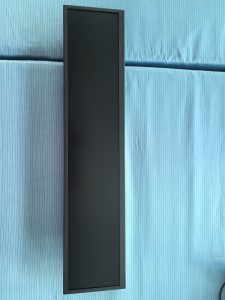
The core commercial value of stretched displays shines in high-frequency pricing environments: prices are modified centrally in software and synchronized to shelf displays over local networks, eliminating manual floor patrols. For example, ZXTLCD’s 36.2-inch stretched display features an integrated Android compute engine with Wi-Fi and Ethernet connectivity, pairing seamlessly with compatible digital signage software. Inform our engineering team of your preferred software during planning to verify compatibility.
Question 2: How Many Shelf Display Points Do You Operate?
For small boutiques with a handful of shelves, manual tag swapping is easily managed, and the competitive advantage of digital displays is modest.
As shelf counts expand—particularly across multi-branch retail chains—centralized management becomes an operational necessity. Updating campaigns centrally from headquarters ensures brand compliance, eliminating the communication lag and human error of individual store teams. Conversely, for a single small boutique with few aisles, investing in a complete digital display network may deliver low capital ROI.
Question 3: What Content Do You Aim to Showcase Beyond Basic Price Digits?
Traditional paper tags accommodate minimal data: item title and numeric price fill the entire slip.
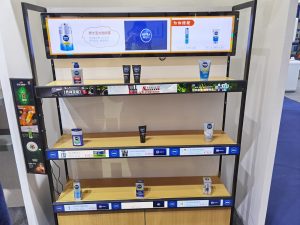
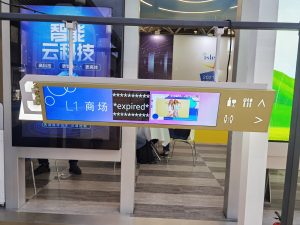
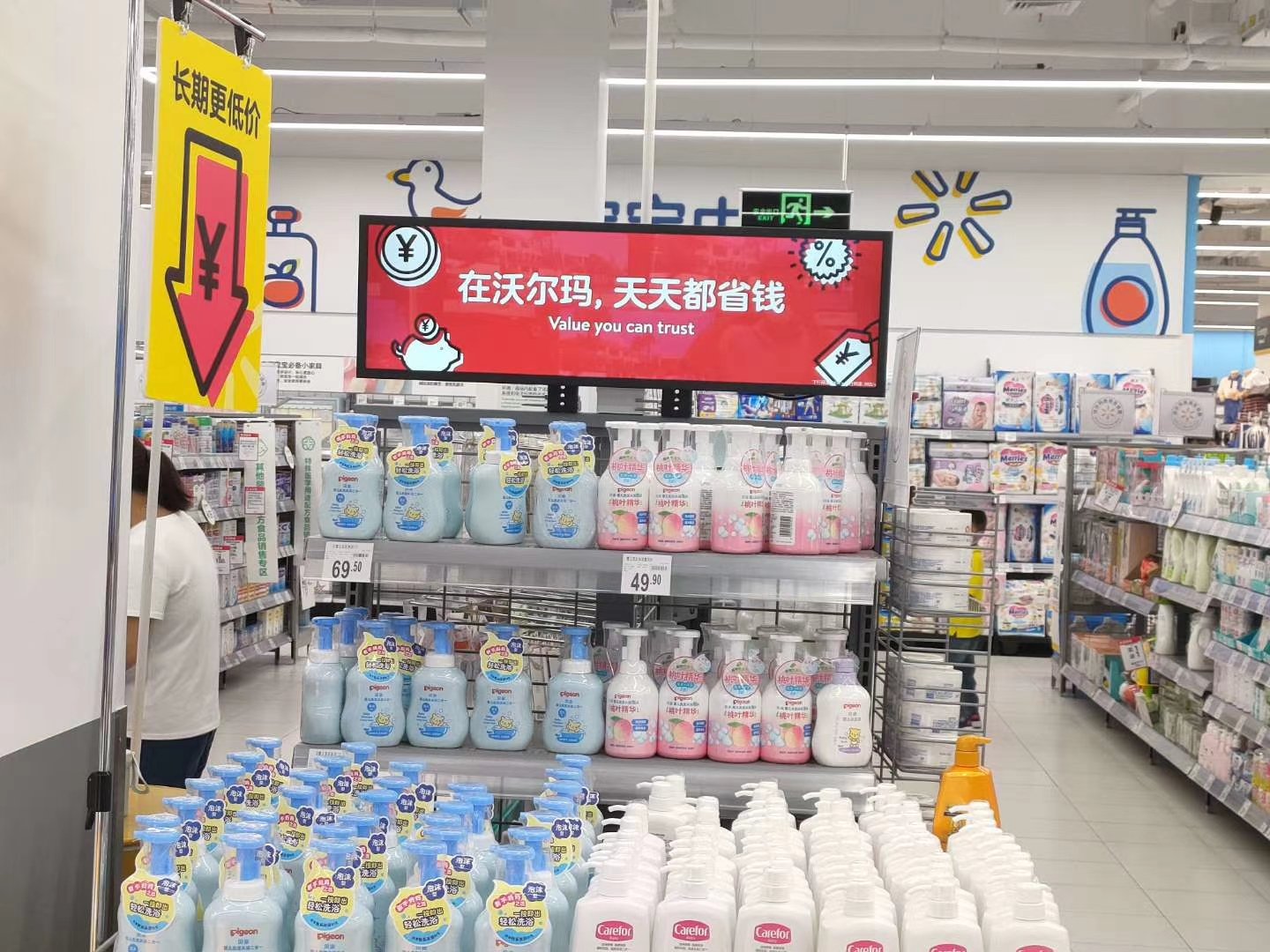
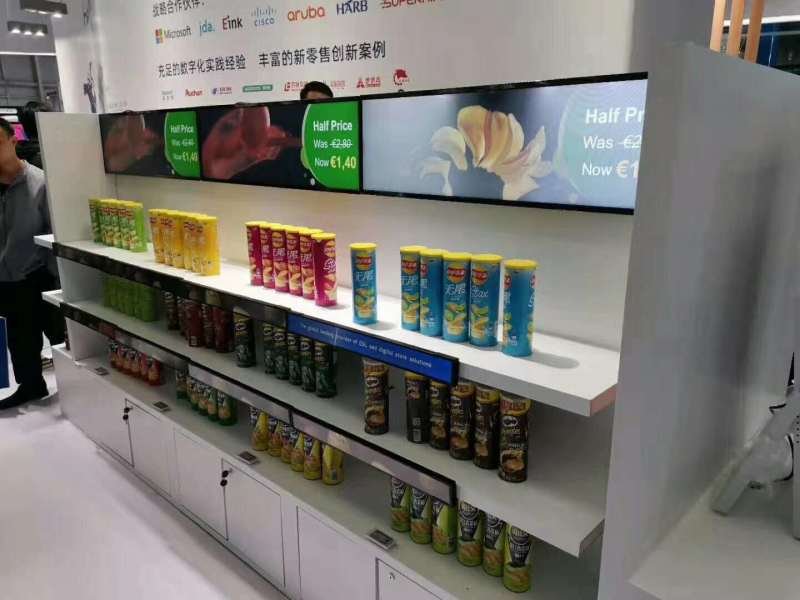
If you aim to leverage shelf edges to broadcast promotional slogans, product origin highlights, pairing recommendations, and dynamic video animations, stretched displays provide the necessary visual canvas. Their ultra-wide, narrow form factor mounts flush along shelf edges where standard monitors cannot fit.
However, evaluate creative resources realistically: Who will design the digital content? Because stretched displays utilize non-standard aspect ratios, creative media assets must be authored directly to native pixel dimensions to prevent image stretching or black pillarbox bars. If store staff lack the bandwidth to maintain creative assets, digital screens risk being underutilized.
Question 4: Does Your Budget and Physical Environment Align with Stretched Displays?
The initial capital expenditure of digital stretched displays exceeds paper tags—an unavoidable commercial reality. Non-standard dimensions involve custom engineering, where small production batches carry higher unit costs.
Furthermore, our commercial stretched displays are engineered primarily for indoor commercial retail spaces (supermarket aisles, convenience store counters, pharmacy shelves); they are not waterproof outdoor products. If displays must deploy outside exposed to driving rain, dedicated outdoor-rated screens are required.
Synthesizing Your Decision Framework
Upgrade to Stretched Bar Displays If: Prices rotate frequently, shelf counts are substantial, management seeks to enrich shelf merchandising with dynamic multimedia, and capital budgets accommodate digital modernization.
Stick with Paper Price Tags If: Prices remain stable year-round, shelf counts are minimal, simple price digits are the sole requirement, and capital budgets are tightly constrained.
For retail stores situated in between, conduct pilot trials across high-traffic promotional endcaps for one to two months, measuring labor savings and sales lift before deciding on storewide rollouts.
Pre-Implementation Checklist
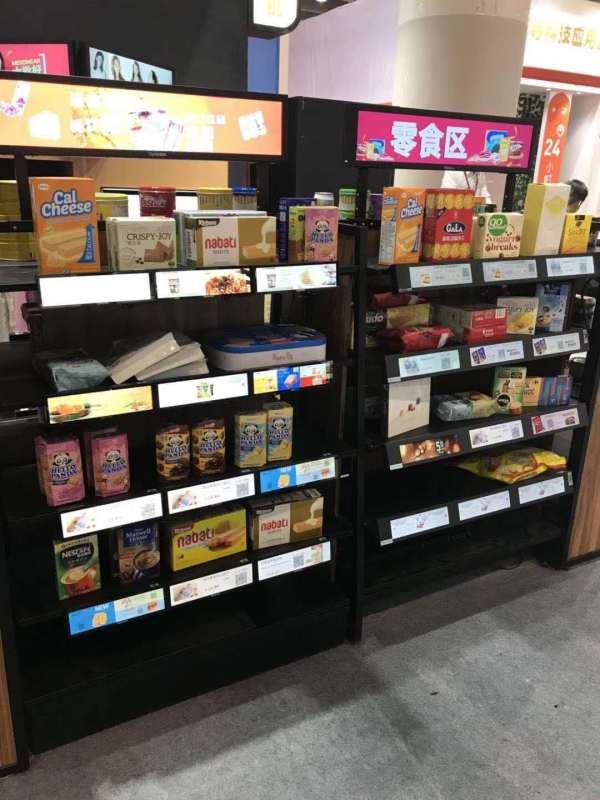
Measure available shelf length and height to dictate screen aspect ratio. Establish content production workflows and update schedules. Confirm in-store Wi-Fi or wired network stability. Determine whether integration with existing POS price databases is needed. Select the mounting method (shelf-edge clips, header brackets, or recessed channels).
ZXTLCD provides custom dimensional engineering tailored to exact retail gondola specifications.
Conclusion
Paper price tags and stretched bar LCD displays are not mutually exclusive adversaries; they simply serve distinct retail profiles. For fast-paced, multi-store retailers with dynamic promotions, stretched displays streamline operations and drive merchandising impact; for small, stable boutiques, paper tags remain a practical, economical choice. Answering these four questions ensures you choose the hardware strategy best aligned with your commercial realities.
ZXTLCD specializes in commercial-grade LCD stretched bar displays with full dimensional customization. If your retail store requires tailored shelf price display solutions, share your gondola specifications, store counts, and application scenarios with our team for professional consultation. Official website: stretchedbarlcd.com/” target=”_blank” rel=”noopener”>www.stretchedbarlcd.com
Explore Related Commercial Stretched Bar LCD Models
If you are sourcing high-reliability stretched display hardware for this application, consider these featured commercial specifications:
- 28 Inch Android Stretched LCD Bar for Shelf-Edge Signage
- 47.1 Inch Android Stretched Bar LCD Screen for Shelf Edges
- 58.4 Inch Stretched LCD Display for Retail Shelf Headers
Need a Custom Screen Size or Turnkey Project Quote?
ZXTLCD provides full ODM/OEM customization for commercial projects—including ultra-wide aspect ratios, sunlight-readable high brightness, custom mounting brackets, and Android/Windows CMS software integration.