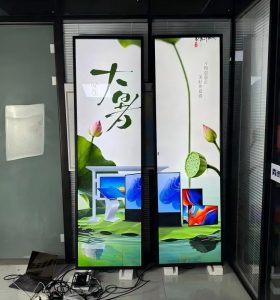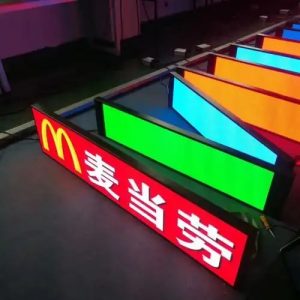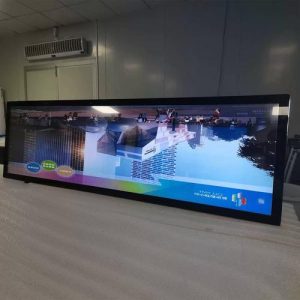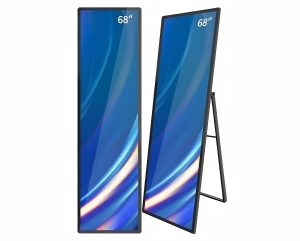

In today’s digitalized and information-driven era, display technology has permeated every corner of daily life, ranging from handheld smartphones to colossal public digital signage. Among these technologies, the LCD stretched bar display has emerged as a prominent commercial medium whose operational principle is both ingenious and sophisticated. This article explores the internal mechanisms of LCD stretched bar screens to provide a clear technical understanding.
1. Fundamental Characteristics of Liquid Crystals
Liquid crystals exist in an intermediate thermodynamic state between crystalline solids and isotropic liquids, possessing both the fluid mobility of liquids and the optical anisotropy of crystals. Liquid crystal molecules exhibit optical birefringence and optical rotation. When influenced by an external electric field, the molecular orientation shifts, altering light polarization and transmittance. This electro-optical property makes liquid crystals an ideal medium for dynamic display engineering.
2. Structural Composition of LCD Stretched Bar Displays
An LCD stretched bar display module comprises several high-precision optical and electrical layers, including the liquid crystal layer, color filter, glass substrates, backlight unit, polarizing films, and driver circuitry.
Liquid Crystal Layer: Formed by precision-oriented liquid crystal molecules hermetically encapsulated between two parallel glass substrates. Molecular alignment is regulated by transparent conductive electrode patterns (such as ITO) deposited on the inner glass surfaces.
Color Filter: Located adjacent to the subpixel matrix to produce full-spectrum color. Each complete pixel consists of individual Red, Green, and Blue (RGB) subpixels whose additive optical blending renders the full visible color gamut.
Glass Substrates: Act as the structural foundation housing the liquid crystal cell, carrying transparent pixel electrodes and thin-film transistors (TFTs) that apply localized voltage across each subpixel.
Backlight Unit: Because liquid crystals do not emit light natively, a high-uniformity LED backlight array provides stable, bright illumination that traverses through the panel assembly to deliver visible images.
Polarizing Films: Placed on the front and rear outer faces of the glass cell with mutually perpendicular polarization axes. As polarized light traverses the voltage-modulated liquid crystal layer, optical phase retardation determines how much light successfully emerges through the front polarizer.
Driver Circuitry: Encompassing timing controllers (T-Con), source/gate driver ICs, and power management units, this circuitry translates input video data into precise analog voltage potentials across millions of subpixels while governing backlight luminance levels.
3. The Operational Working Principle
The operational core of an LCD stretched bar display relies on electrical modulation of liquid crystal molecular orientation to precisely govern light transmittance, thereby forming coherent imagery.
Electric Field Modulation: Applying voltage across the liquid crystal layer reorients molecular alignment. In traditional Twisted Nematic (TN) panels, molecules maintain a 90-degree twist in the relaxed state, aligning perpendicular to substrates under an applied field. In modern In-Plane Switching (IPS) panels, molecules rotate parallel to the substrate surface within the plane of the electrodes, securing superior color consistency and ultra-wide 178-degree viewing angles.
Polarization Gating: When molecular alignment guides polarized light to match the transmission angle of the front polarizer, light passes freely to yield bright pixels. When molecular deflection disrupts alignment, light is absorbed by the polarizer to produce true black. Micro-adjusting voltage creates thousands of grayscale levels.
Full-Color Image Synthesis: By independently modulating the grayscale luminous output across millions of Red, Green, and Blue subpixels, the panel achieves rich color gradations and photorealistic full-motion video.
4. Applications and Technological Evolution
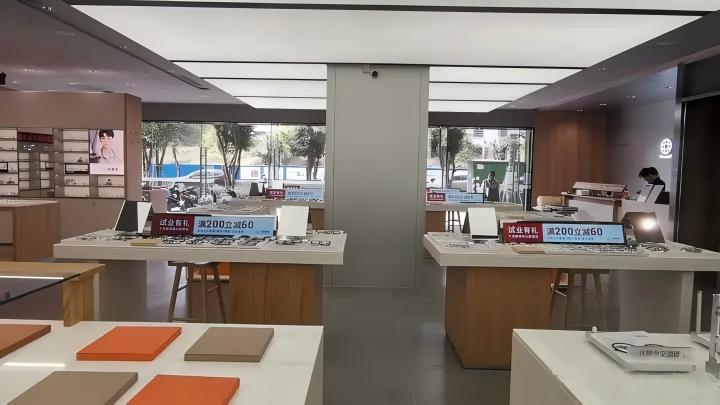
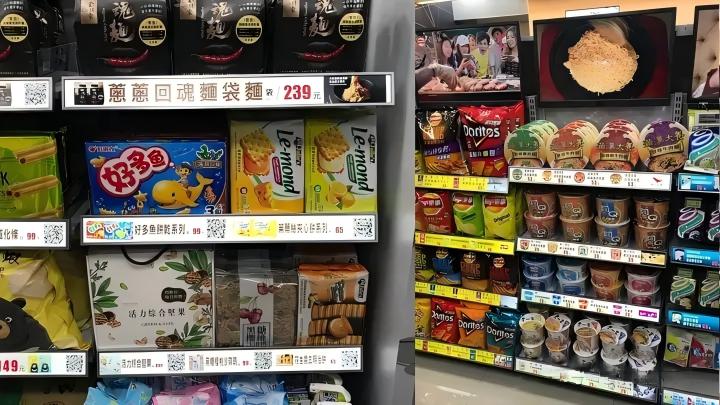
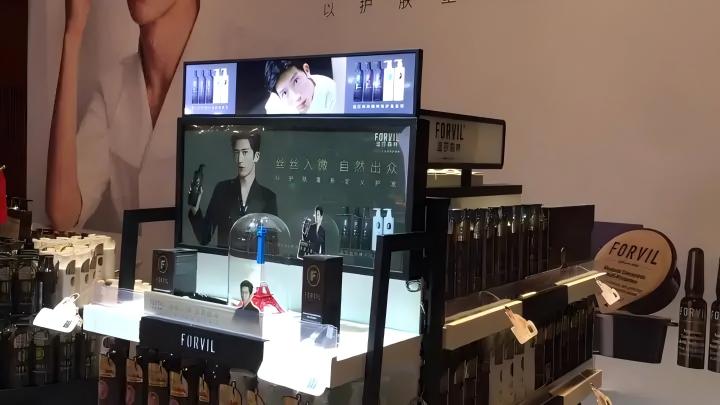
Benefiting from high pixel density, low operational power consumption, slim profiles, and long industrial lifespans, LCD stretched bar screens have achieved widespread adoption. In commercial shopping malls, shelf-edge bar displays dynamically showcase product promotions to capture shopper foot traffic; across public transit networks, stretched passenger information displays deliver real-time route progress and transfer guidance. Continuous innovations in resolution, high-gamut backlights, and wide-temperature durability ensure that stretched bar LCDs remain pivotal visual assets in smart retail, transportation, and industrial automation.
Explore Related Commercial Stretched Bar LCD Models
If you are sourcing high-reliability stretched display hardware for this application, consider these featured commercial specifications:
- 88 Inch 4K Ultra Wide Stretched Bar LCD Monitor
- 28 Inch Android Stretched LCD Bar for Shelf-Edge Signage
Need a Custom Screen Size or Turnkey Project Quote?
ZXTLCD provides full ODM/OEM customization for commercial projects—including ultra-wide aspect ratios, sunlight-readable high brightness, custom mounting brackets, and Android/Windows CMS software integration.